It was the second anniversary of my mother’s death—a day marked by 90-degree humidity and an air so still it felt as though the land itself was holding its breath. I decided that the best way to occupy the day was through physical, intentional labor. I headed out to the perimeter of the yard along the tree line, a chore that demands constant attention when the weather turns warm. I ended up staying out there for two and a half hours, working to beat the heat of the approaching afternoon.
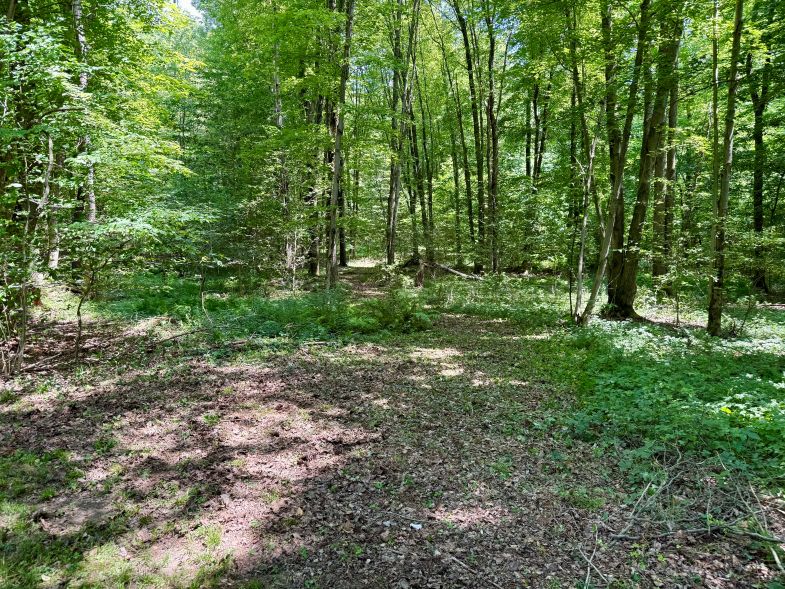
The beginning of the path, opening a way into the woods.
A Day of Work
There is something different about work that asks you to use your whole body. Clearing brush leaves very little room for the mind to wander. You notice what is directly in front of you: the ground underfoot, the heat on your shoulders, the next tangle that needs to be moved. The work is physical, but it also has a way of bringing attention back to the present.
While working in the northeast corner of the back yard, I noticed the way the morning light cut back on a diagonal, carving out a slice of the woods I hadn't looked at closely before. I told myself, let’s create a path back there and see what’s actually going on.
Following the Light
That decision pulled a dormant memory to the surface: a walk through this same area years ago, long before this house existed, when the land was just a barren, abandoned orchard. I remembered a female figure showing me where the teaberry grew, and the distinct, sharp taste of the leaves.
I had not set out that morning to revisit that memory. It simply arrived as I began opening the ground again. That is part of what made the work feel less like a project with a fixed destination and more like a conversation with a place I had known, forgotten, and was now beginning to notice again.
As I cleared the dense, ivy-like strawberry groundcover, the path began to reveal itself. I crossed a small, dry creekbed and climbed a slight rise that opened into the clearing. There, I found two trees that had fallen long ago, settling across one another in a perfect “X.” I don’t believe in coincidences; finding that mark felt like a quiet affirmation that I was meant to find this spot.
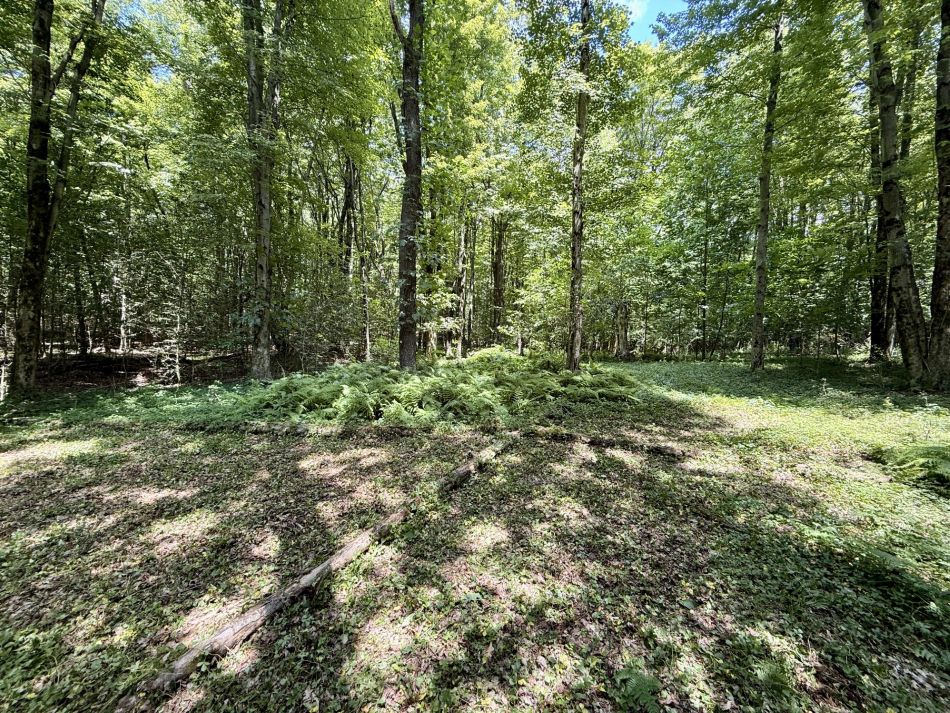
The fallen trees that marked the clearing.
Letting the Land Lead
I’m letting the terrain dictate the turns rather than imposing a design. It’s an act of listening. The path bends because the ground asks it to bend, not because I have drawn a straight line and decided the woods should follow it.
And I’m finding that I won't be the only one using this route. The deer trails already weave through the woods, and I’m essentially opening a path that we’ll be sharing. That makes the project feel less like building something onto the land and more like revealing a route that was already being used.
The Clearing Ahead
As for what becomes of the clearing, I’m not sure yet. I imagine a quiet, intentional spot for meditation, but I’m hesitant to clutter it with furniture. I want to ensure that whatever I add truly honors the space.
And, practically speaking, if this is going to be a place where one stops to tune into the rhythm of the woods, it has to be a place where you can sit still without being overwhelmed by the local insect population.
The Path Is the Practice
For now, the path itself is the project. It’s a labor of discovery, clearing a few more feet of earth each time I’m out here, watching it wind its way deeper into the timber.
There is a specific clarity to be found in the heat and the exertion, a way of grounding myself in what is here, right now, in my own backyard. The work does not erase the reason I went outside that day, and it doesn't need to. It gives the day somewhere to go.
Maybe that is what makes the path feel meaningful. I started by looking for something to do with a difficult day, and ended up paying closer attention to the land around me. A little at a time, the route is becoming visible—and for now, that is enough.